How Samva sets up customer domains with DomainKit
How Samva, an email API, lets customers add a sending domain without copying DNS records. The records, the flow, and what the customer approves.
Samva
An email API with Git-backed TSX templates.
| Customer | Uses | Providers | Records written | Status |
|---|---|---|---|---|
| Samva | domainkit, @domainkit/react, and @domainkit/capsuledb |
Cloudflare and Vercel | TXT, MX, and CNAME | In production |
Samva sends email for its customers from their own domains. Before it can, each domain needs a set of DNS records at the customer’s provider. Samva uses DomainKit to add those records after the customer reviews and approves them.
What an email sending domain needs
A customer who wants to send from mail.example.com has to prove the domain is theirs and
authorize Samva to send for it. That takes records in their DNS.
| Type | What it does | Policy in Samva |
|---|---|---|
TXT |
SPF and domain verification | Append. Other TXT records at the same name are fine. |
MX |
The mail-from address and receiving | Exclusive. A second MX at that name would break the first. |
CNAME |
DKIM signing and click tracking | Exclusive. One target per name. |
Samva also checks for a DMARC record and recommends one. DomainKit doesn’t write it, and a missing DMARC record doesn’t block verification.
Why a table of records to copy isn’t enough
A table of records for the customer to add at their DNS provider is where setup stalls. Each record has a host and a value, and the values are long and exact. Registrars format the host column differently, and one wrong character means the domain doesn’t verify.
Other email products describe the same steps in their own docs, with a variant for each registrar. See the examples in Copy-paste DNS instructions and where they break.
Onboarding gets difficult mainly because of DNS. Copying and pasting records is error-prone and it increases support cases. That’s what we built DomainKit to solve.
Saatvik Arya, founder, Samva
How the flow works
The customer adds a domain.
Samva asks DomainKit which provider serves it. If it’s Cloudflare or Vercel, Samva offers to connect.
They connect once.
Cloudflare uses OAuth. Vercel uses a marketplace install. A token works for either.
They review the records.
A table shows each TXT, MX, and CNAME as a record to add, a record that is already set, or a conflict. Nothing has changed yet.
They approve and apply.
One press adds the approved records, and Samva keeps the receipt.
DomainKit checks that the records resolve.
Samva shows each record’s status, when it last read public DNS, and a Check now button. When every record resolves, the domain is verified.
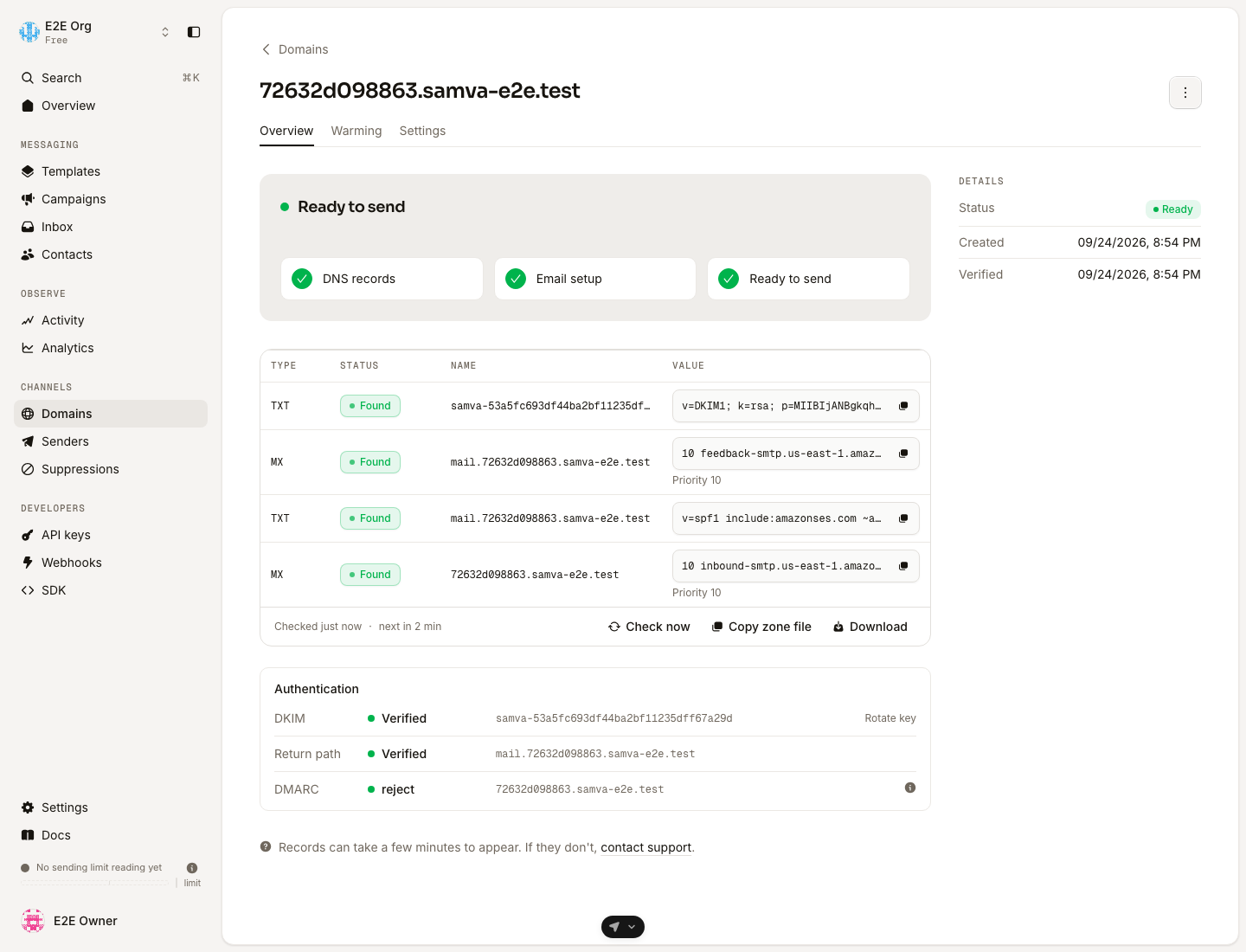
Samva’s domain page.
If the provider isn’t Cloudflare or Vercel, the same page lists the records with copy buttons, so the customer adds them by hand.
Removing a domain later is a separate step, planned from the receipt, so DomainKit only removes records it added.
Who can do what
DomainKit doesn’t decide who may connect a provider or change DNS. Samva does.
| Role | What it can do |
|---|---|
| Organization member | View the domain, its records, and its status. Nothing they can reach spends a credential or writes DNS. |
| Organization owner or administrator | Connect a provider, approve a plan, apply it, and clean up. |
Samva lists every DomainKit endpoint and says which role may reach it. A new endpoint fails to
compile until Samva decides. The same split is the authorize step
of a host integration.
Where the credentials live
Samva seals each provider credential with the same key that protects its other tenant secrets. The
rows live in Samva’s own Postgres, through @domainkit/capsuledb. The browser never sees a
credential. DomainKit is a library inside Samva’s API, so no third party holds its customers’
tokens.
What DomainKit doesn’t do for Samva
It writes DNS records. It doesn’t send mail, sign messages, or decide whether a domain may send. Those stay in Samva. It also can’t write to a provider other than Cloudflare or Vercel, so some customers still add records by hand.